Corporate Social Responsibility Project
Waste to Energy Project
A Biogas Village: Nothing Goes to Waste
The biogas production and garbage recycling training was conceived after people in Ban Thasee decided to get rid of the animal waste, especially those from cattle that were scattered around their village. The project commenced in 2010 with 42 ponds. Two years later in 2012, the villagers formed a group and asked for a grant from PTTEP which operates the Sinphuhom natural gas exploration and production nearby. The villagers did so after they learned from word of mouth that biogas ponds can produce gas for household use.
Adopting biogas has many benefits. It provides savings on household expenses while being an effective way to dispose of garbage.
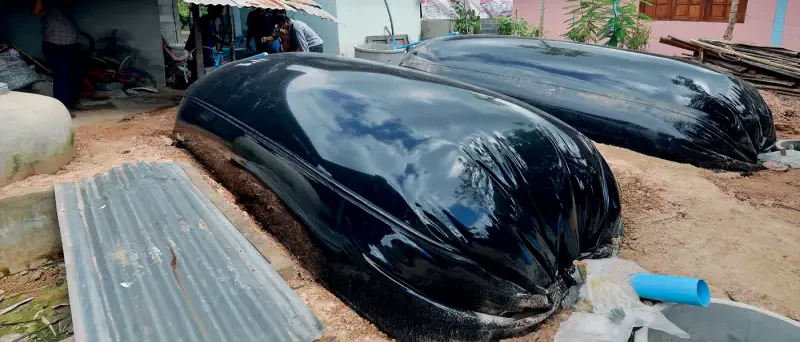
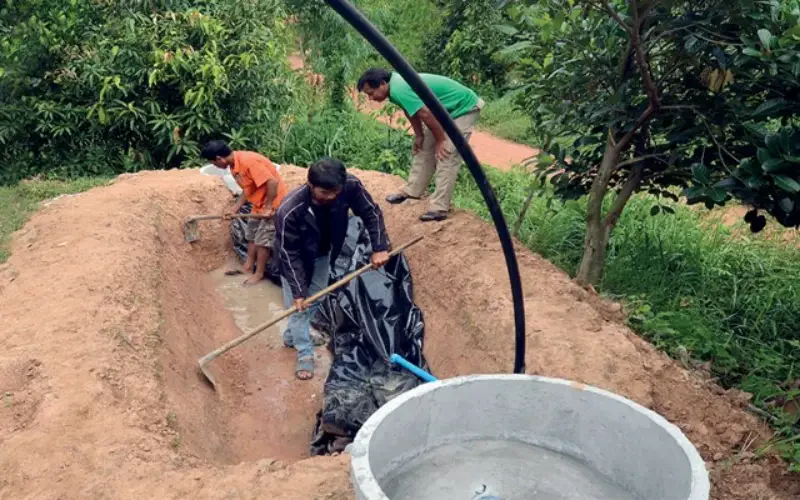
Villagers help one another to install a biogas lagoon and lay a gas pipe to the kitchen.
The fermentation tank looks like a large capsule. The plastic cover appears tight and swollen from the biogas accumulated inside. The lagoon is about 1.7 metres wide and four metres long. It is about 80 centimetres deep on the front end widening to about 1 metre deep at the other end. After digging up the lagoon, villagers then line it with a large plastic sheet.The production of biogas inside the lagoon is a rather simple process. As the animal waste, garbage or organic leftovers decompose, the digestion process naturally produces gas.
In case too much raw material is added into the pond or it rains, excess water will be drained off the rear end of the lagoon. The fermented water can be used to water trees.
The lagoon will also be equipped with another valve pipe where gas will be allowed to travel. This pipe is then connected to various kitchens in different households.
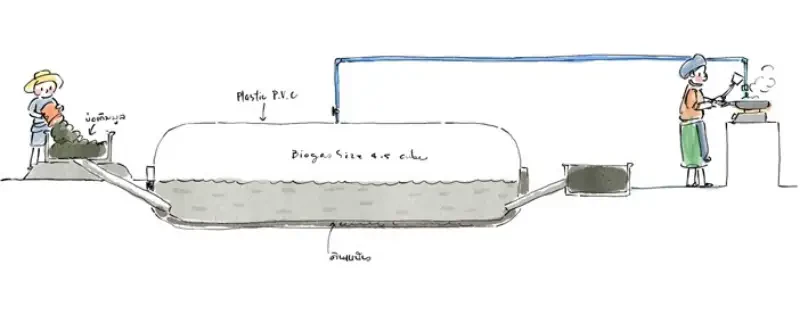
A diagram shows a biogas lagoon using fermented animal feces or leftover food that is fed into a plastic bag. Once biogas is produced, it will run into a pipeline that is fed into households.
To date, more than 700 households in Thailand and abroad have signed up for PTTEP's Waste to Energy Project, having cut their expenses on cooking gas by over 4,200 THB per household per year or a total of 2,700,000 THB per year. The project has disposed over 325 tonnes of biological waste and at least 470 tonnes of household waste per year. At least 75 tonnes of organic fertilizers have been produced, saving expenses of fertilizers for their plantation.
The Waste to Energy Project received international awards including Asia’s Best CSR Practices 2021 (India), Global CSR Awards 2020 (Vietnam), Energy and Environmental Foundation Global CSR Awards 2019 (India), Asia-Pacific Stevie Awards 2018 (Hong Kong)
PTTEP has carried out analysis on Social Return on Investment (SROI) of this project by measuring the social impact of the program with the financial quantification calculation (monetization). It appears that the value of the SROI ratio is 3.66:1.